E-mail:
tina@yuzechemical.com
Contact: Tina Pan
Email: tina@yuzechemical.com
Wechat: +8618660611992
Whatsapp: +8618660611992
Address: Xinxing Village, Dajiawa Street, Binhai Economic Development Zone,Weifang City ,Shandong Province,China.
Website: www.wfyuzehg.com
Conclusion: They are the same substance — magnesium chloride hexahydrate (MgCl2·6H2O). The only difference lies in the forming method and particle size adopted by magnesium chloride flakes manufacturers. Magnesium chloride flakes feature wide compatibility and low price; magnesium chloride granules excel in flowability, anti-caking performance and low dust; magnesium chloride powder stands out for fast dissolution.
The chemical formula of magnesium chloride is MgCl2. The common commercial form is its hexahydrate MgCl2·6H2O, molecular weight 203.3. The theoretical MgCl2 content is about 46.8%. Industrial products are generally 45%–47% calculated as MgCl2.
Magnesium chloride flakes, granules, powder and blocks are all made from bittern, the mother liquor left after salt crystallization from seawater solar evaporation. The simple production flow of magnesium chloride hexahydrate from magnesium chloride flakes manufacturers: brine purification → concentration & crystallization → dehydration & forming → crushing & screening. The first three steps are identical. Differences occur at the forming stage:
· Molten material is cooled and rolled into thin sheets, then crushed and screened to get magnesium chloride flakes
· Granulation, spray granulation or extrusion rounding produces magnesium chloride granules
· Crystallized material is directly crushed and sieved to get magnesium chloride powder
· Cooled into large blocks and coarsely crushed for industrial feeding, namely magnesium chloride blocks
So “which one is better” is not a proper question. The real question is: which form matches your feeding method.
This traditional brine process is different from acid-process / chemical synthetic magnesium chloride flakes, with mature and stable technology.
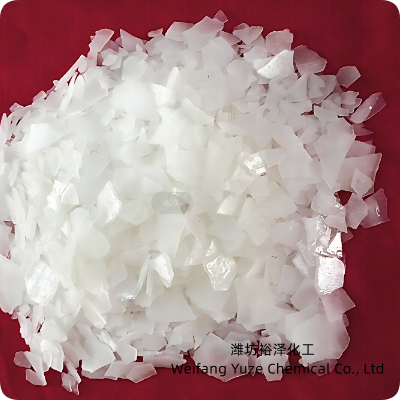
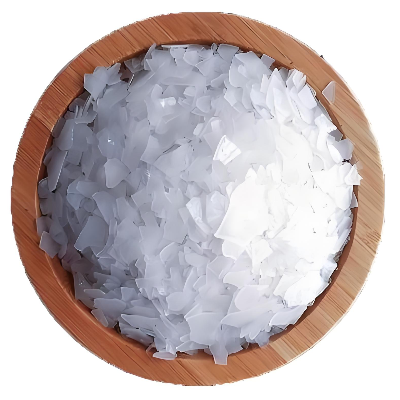
Appearance & specification: irregular thin sheets, 1–3 mm. Color ranges from white, light yellow, light brown to milky white, determined by brine source and impurity removal.
Features
· Wide applicability: widely used for de-icing, magnesia cement, water treatment, bath salt repacking, the most common form on the market
· Low cost: all other forms are further processed from flakes, so flakes have fewer working procedures and lower cost
· Easy weighing: visible individual sheets, stable weight for small bags, good for retail
· Moderate dissolution rate: medium specific surface area; sheets stack and sink without stirring, requiring time to dissolve
Yuze, a professional magnesium chloride flakes manufacturer, supplies flakes with low impurities and weaker caking tendency. They can be stored longer under the same storage condition.
Limitations: poor flowability on automatic production lines, easy bridging in hoppers; thick flakes dissolve much slower than thin ones.
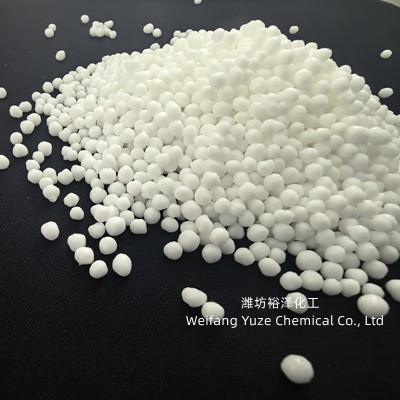
Appearance & specification: nearly spherical or irregular granules, common particle size 2–5 mm, relatively dense surface.
Features
· Good flowability: low friction between particles, smooth for screw conveying, batching and automatic filling with low weighing error
· Strong anti-caking capacity: smaller specific surface area, slower moisture absorption than powder. Stable condition for long-distance sea shipment and high-humidity hot regions
· Extremely low dust: clean feeding environment, friendly to operators
· Moderately fast dissolution: good dispersion in water, no stacking like flakes, usually faster than thick flakes
· Higher production cost: extra granulation process, higher ton price than flakes and powder
Limitations: granules of large size still need stirring for full dissolution in cold water; high proportion of fine particles weakens its flow advantage.
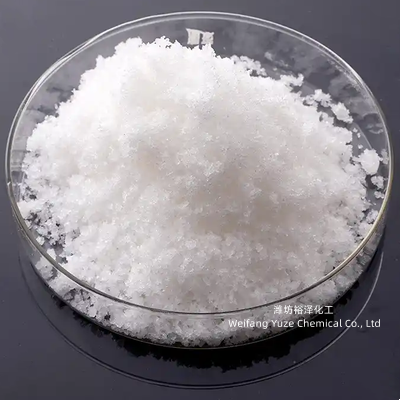
Appearance & specification: white or light-colored powder, particle size mostly below 0.5 mm, finer grades available.
Features
· Fast dissolution: disperses quickly once contacting water, high liquid preparation efficiency
· Easy to blend with other powders: uniform distribution for compound formulations such as fire inhibitors, flocculants and de-icing blends
Limitations: highly prone to caking. Moisture absorption makes particles stick together and form hard lumps after long storage. Strict storage required; seal tightly and finish use quickly once opened.
Dimension | Magnesium chloride granules | Magnesium chloride powder | |
Particle size | 1–3 mm | 2–5 mm | ≤0.5 mm |
Dissolving speed | Medium | Moderately fast | Fast |
Dust | Low | Very low | High |
Flowability | Fair | Good | Poor |
Caking tendency | Low | Low | High |
Metering accuracy | Good | Good | Fair |
Transport stability | Good | Good | Poor |
Price level per ton | Low | High | High |
No matter the appearance, technical parameters must first meet your production requirements. Then follow the rules below: Step 1: Check feeding method. Manual feeding → flakes; automatic metering → granules; pipeline liquid preparation → powder. Step 2: Check storage and transport. Sea freight, rainy season, long-term inventory → granules preferred; local short transport, fast turnover → flakes or powder are acceptable. Step 3: Check dissolution requirement. If fast liquid preparation is needed without heavy dust trouble, choose fine-size granules. This is a practical compromise adopted by many magnesium chloride flakes manufacturers: smaller size speeds up dissolution while granular shape keeps good flowability.
Previous: Magnesium chloride application in agriculture: crops and vegetables not recommended for use