
E-mail:
tina@yuzechemical.com
Contact: Tina Pan
Email: tina@yuzechemical.com
Wechat: +8618660611992
Whatsapp: +8618660611992
Address: Xinxing Village, Dajiawa Street, Binhai Economic Development Zone,Weifang City ,Shandong Province,China.
Website: www.wfyuzehg.com
Many customers use magnesium chloride hexahydrate white flakes after dissolving them in water, so they have strict requirements on impurities and clarity of the solution. With 13 years of experience in this industry, Yuze is a professional magnesium chloride white flakes supplier. We can supply high-clarity magnesium chloride hexahydrate white flakes with fewer impurities. Today we break down the main causes of cloudiness.
The whitening and cloudiness of dissolved magnesium chloride hexahydrate white flakes mainly fall into three categories: magnesium ion hydrolysis, raw material impurities and solution preparation practices. Hydrolysis triggered by excessively high water temperature is common and often mistaken for product quality defects. Other causes include excessive sulfate, basic magnesium chloride and water-insoluble matter, as well as hard mixing water or improper feeding methods.
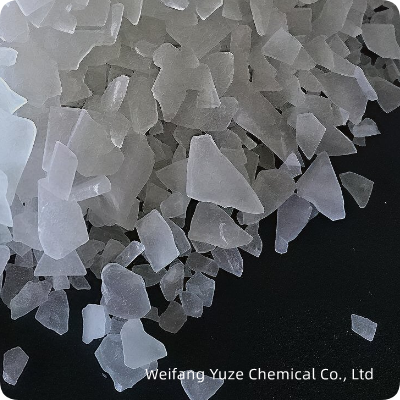
These two phenomena are easily confused, and the solutions are totally different.
Surface whitening: The surface of magnesium chloride white flakes loses gloss and turns pale. It is usually caused by partial hydration or weathering after moisture absorption during storage. It does not change the main content, yet dissolution speed and clarity will decline.
Cloudy solution: The liquid turns milky or grey-white after dissolution, with sediment or stable suspended solids after standing. This is the core issue we discuss here.
Whether the solution stays clear depends on three factors: hydrolysis level, impurity content and mixing conditions. These factors often work together, so troubleshoot step by step.
Magnesium ions undergo hydrolysis naturally in aqueous solution:
Mg²⁺ + 2H₂O ⇌ Mg(OH)₂↓ + 2H⁺
Under certain conditions, fine white particles of magnesium hydroxide or basic magnesium chloride precipitate out, creating milky cloudiness rather than large lumpy sediment.
Three major triggers for hydrolysis:
①High water temperature. This is the top cause. Many users use hot water above 60 ℃ to speed up dissolution. Higher temperature accelerates hydrolysis and worsens cloudiness. Magnesium chloride white flakes dissolve rapidly at 30–40 ℃, hot water is unnecessary.
② Local over-concentration. Feeding a large quantity of flakes at once creates local high-concentration zones with elevated pH, generating hydrolysis by-products trapped inside the pile.
③ Alkaline water quality. Hard or alkaline tap water / groundwater contains bicarbonate ions, which react with magnesium ions to form basic magnesium carbonate and white turbidity.
Feature of this type of cloudiness: uniformly milky liquid, slowly settling solids. The solution becomes noticeably clear after adding a small amount of dilute hydrochloric acid.
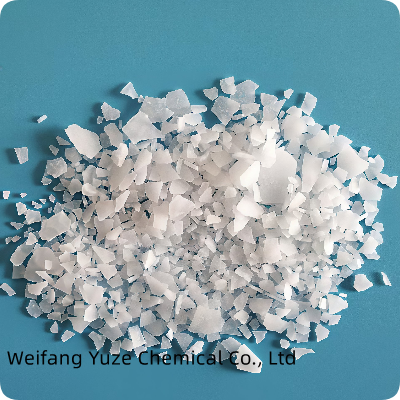
A bright white appearance does not guarantee a clear solution. The following slightly soluble or insoluble components directly cause cloudiness:
1. Sulfates (magnesium sulfate, calcium sulfate) Sulfate is a typical culprit for cloudy solutions. When white magnesium chloride hexahydrate is produced from carnallite mother liquor (old brine), magnesium sulfate and organics inside lead to slow dissolution and turbid liquid. Standard pretreatment for old brine is required: remove magnesium sulfate with calcium chloride, adjust pH to neutral with hydrochloric acid, and decolorize with sodium sulfite. This shortens dissolution time to around 15 minutes and stabilizes clarity. Calcium sulfate is sparingly soluble, and magnesium sulfate solubility drops sharply in concentrated magnesium chloride solution. Both form fine white suspended crystals.
2. Water-insoluble matter Silt, silicate and residual suspended solids from incomplete filtration. Sediment settles quickly, leaving obvious residue on filter paper. Specifications limit water-insoluble content: ≤0.20% for industrial white magnesium chloride (GB 8453), ≤0.10% for food grade (GB 25584-2010).
3. Alkali metal chlorides such as sodium chloride Common ion effect in concentrated magnesium chloride solution reduces sodium chloride solubility, forming white flocculent precipitates. This mostly occurs in highly concentrated brine and clears up after dilution. Acid-process white magnesium chloride rarely has this problem.
· Using hard water or water with suspended solids;
· Fast feeding and insufficient stirring;
· Residual alkaline liquid or uncleaned detergent in dissolution tanks;
· Moist, caked flakes with pre-hydrated surfaces dissolve unevenly.
Step | Operation | Judgment |
① Water replacement test | Dissolve the same batch sample in deionized / distilled water at 30–40 ℃ | Clear solution = water or temperature issue; still cloudy = product quality issue |
② Acid test | Add a few drops of dilute hydrochloric acid | Cloudiness disappears = hydrolysis / carbonate; remains cloudy = basic salts, sulfates or insoluble solids |
③ Filtration & weighing | Filter with quantitative filter paper, dry and weigh residue | Heavy residue = excessive insoluble matter; filtrate still turbid = dissolved impurities |
④ Settlement observation | Let stand for 2 hours | Fast sedimentation = mechanical impurities; persistent milky suspension = basic salts / hydrolysis products |
Key indicators for testing: water-insoluble content, sulfate content, basic magnesium chloride (or loss on ignition).
Products named magnesium chloride white flakes vary greatly among different magnesium chloride white flakes suppliers and factory due to raw materials and production processes. Buyers set different requirements according to end uses, such as solution clarity and sulfate limits.
Q: Is slightly milky magnesium chloride hexahydrate white flakes after dissolution a sign of defective factory product quality?
A: Not necessarily. Retest with deionized water below 40 ℃. If clear, cloudiness comes from temperature or water-induced hydrolysis. If still turbid, test water-insoluble substances, sulfate and basic salt content.
Q: Why does the same batch of white flakes stay clear for some customers but turn cloudy for others?
A: Mixing conditions are the main reason. Water temperature, hardness, feeding speed and stirring intensity all affect hydrolysis. Compare results after unifying the mixing procedure.
Q: What does it mean when cloudiness disappears after adding hydrochloric acid?
A: The turbidity mainly comes from hydrolysis products or carbonates, which can be improved by controlling temperature and pH. If suspended solids remain after acid addition, the problem is likely excessive insoluble matter or sulfate, a product specification defect.
Q: How to quickly verify whether a supplier’s white flakes fit your process?
A: Request samples and run a dissolution test under your actual working conditions (same water, temperature and feeding method). Check the COA for sulfate and water-insoluble content and cross-reference the test result.