E-mail:
tina@yuzechemical.com
Contact: Tina Pan
Email: tina@yuzechemical.com
Wechat: +8618660611992
Whatsapp: +8618660611992
Address: Xinxing Village, Dajiawa Street, Binhai Economic Development Zone,Weifang City ,Shandong Province,China.
Website: www.wfyuzehg.com
Many customers wonder why magnesium chloride flakes have a shelf life of up to two years, yet caking still occurs. Is caking a quality issue? As a manufacturer of magnesium chloride flakes, we provide a detailed explanation below:
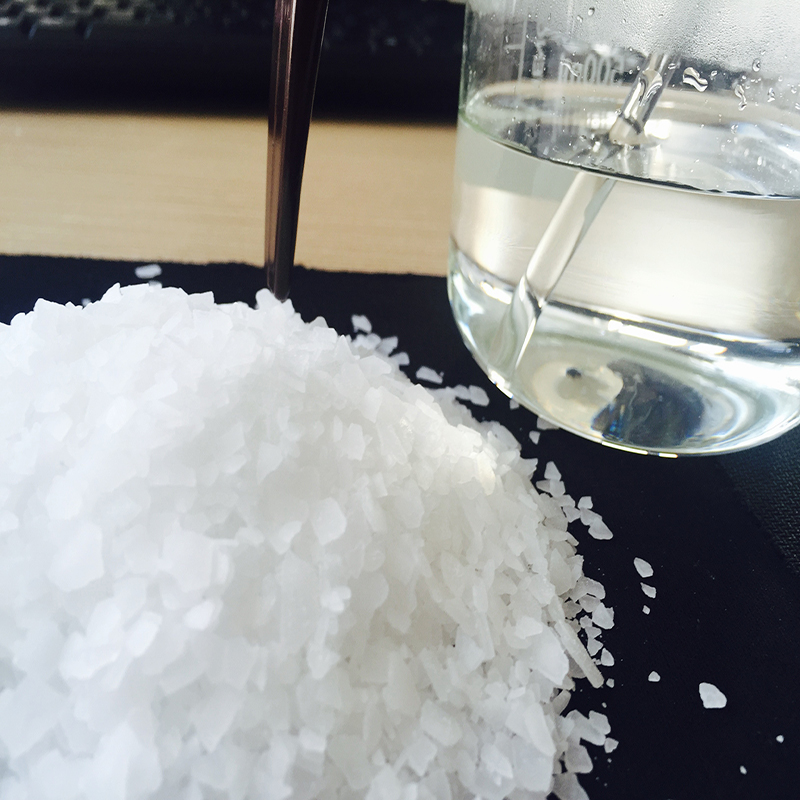
Magnesium chloride flakes have strong hygroscopic properties—they are even used as an ingredient in household desiccants. They readily absorb moisture from the air, forming a saturated solution film on the particle surface and even partially dissolving (deliquescence).Upon receipt, customers should first inspect the packaging for damage. If damaged, the product should be used promptly or repackaged and resealed immediately.
During loading, unloading and transportation, friction and collision between flakes inevitably produce magnesium chloride powder. Under the same storage conditions, magnesium chloride powder cakes much more easily than flakes.
· Air humidity: Caking accelerates significantly when relative humidity exceeds 60%, especially during rainy seasons, in coastal areas or high-humidity southern regions.
· Broken or poorly sealed packaging: Loose seals, tears or breathable packaging allow continuous moisture absorption—the most common cause of caking in industrial and warehouse storage.
· Stack pressure and storage time: Long-term stacking compresses particles, promoting liquid bridge formation and solidification; caking becomes harder with longer storage.
· Temperature fluctuations: Higher temperatures speed up moisture absorption, while cooling or drying intensifies recrystallization. Diurnal and seasonal temperature changes trigger repeated “absorption–recrystallization” cycles.
Magnesium chloride flakes include halogenated flakes, by-product flakes and acid-process flakes. Tests under identical storage conditions show that acid-process magnesium chloride flakes (our main product as a magnesium chloride flakes manufacturer) are more resistant to caking.
The typical shelf life of magnesium chloride flakes is 1–2 years (our main product has a 2-year shelf life).To maximize storage life:
1. Inspect packaging upon receipt for obvious damage.
2. Check that the inner liner is properly heat-sealed with no gaps.
3. Store properly:
o Keep relative humidity ≤ 60%.
o Avoid damp, open-air or rainy conditions.
o Store at room temperature, away from direct sunlight.
o Maintain warehouse ventilation to prevent moisture buildup.
o Never place directly on floors, near walls or water sources; always use pallets or shelves.
Previous: Is Magnesium Chloride a Salt?
Next: Can anhydrous magnesium chloride really reach a content of 99.9%?