
E-mail:
tina@yuzechemical.com
Contact: Tina Pan
Email: tina@yuzechemical.com
Wechat: +8618660611992
Whatsapp: +8618660611992
Address: Xinxing Village, Dajiawa Street, Binhai Economic Development Zone,Weifang City ,Shandong Province,China.
Website: www.wfyuzehg.com
Magnesium chloride hexahydrate (MgCl₂•6H₂O) is not a precipitate under normal conditions, but whether it forms a precipitate depends on factors such as concentration, temperature, solvent, and coexisting ions. Here is a detailed analysis:
· Behavior in Aqueous Solution: Magnesium chloride is a strong electrolyte that completely dissociates into magnesium ions (Mg²⁺) and chloride ions (Cl⁻) in water. According to solubility tables, magnesium chloride hexahydrate is highly soluble in water, with a solubility of approximately 54.6 g/100 mL at 20°C, so it does not spontaneously form a precipitate.
· Solubility Trend: Solubility increases with temperature. For example, at 100°C, the solubility can reach approximately 74 g/100 mL, further demonstrating its high solubility.
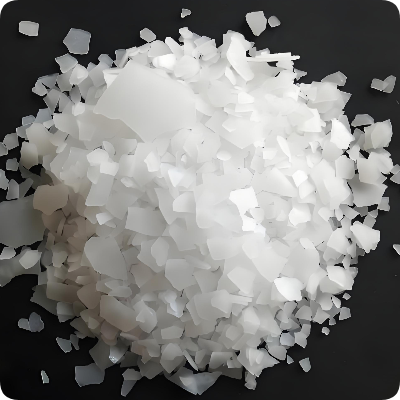
Although magnesium chloride itself is highly soluble, it may form a precipitate under the following conditions:
· Evaporation of Highly Concentrated Solutions: When magnesium chloride solutions are concentrated to a supersaturated state, magnesium chloride hexahydrate (MgCl₂•6H₂O) crystals may precipitate, but this is a physical crystallization process rather than a chemical precipitation.
· Reaction with Specific Reagents:
o Sodium Hydroxide (NaOH): If both Mg²⁺ and OH⁻ ions are present in the solution and their concentrations exceed the solubility product (Ksp ≈ 1.8×10⁻¹¹) of magnesium hydroxide (Mg(OH)₂), a white precipitate will form:
Mg2++2OH−→Mg(OH)2↓
o Carbonates (e.g., Na₂CO₃): Similarly, Mg²⁺ reacts with CO₃²⁻ to form magnesium carbonate (MgCO₃) precipitate:
Mg2++CO32−→MgCO3↓
· Solubility in Organic Solvents: In organic solvents such as ethanol and acetone, the solubility of magnesium chloride decreases significantly, potentially leading to solid precipitation. However, this is a solvent effect rather than a traditional precipitation reaction.
In our production process of magnesium chloride hexahydrate, referring specifically to the primary production type (not by-products), we typically perform secondary filtration (allowing the solution to stand for a period of time to facilitate secondary precipitation of any sediment) to ensure the clarity of the solution after dissolution by users. Therefore, the quality of magnesium chloride hexahydrate varies according to different user requirements. For example, differences in production processes such as by-products from nitrate production, by-products from pharmaceutical intermediates, brine processes, and primary production types (reaction of magnesium oxide, magnesium hydroxide, and hydrochloric acid) result in variations in price.
· Under Normal Conditions: Magnesium chloride is highly soluble in water and does not form a precipitate.
· Under Special Conditions: Precipitation (e.g., Mg(OH)₂, MgCO₃) can be induced by evaporation and concentration, pH adjustment, or the addition of specific reagents.
Our Yuze Magnesium Chloride Factory has 13 years of experience in producing anhydrous magnesium chloride and magnesium chloride hexahydrate products. We have a deep understanding of user needs for these products across different industries. If you have any questions, please feel free to consult us, and we will respond as soon as possible.