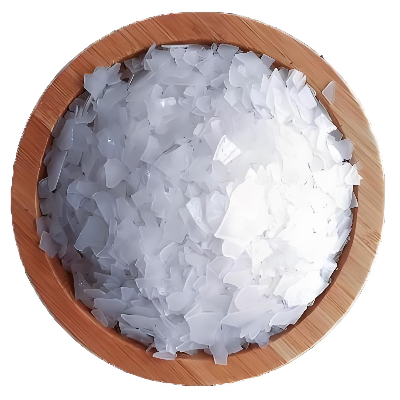
E-mail:
tina@yuzechemical.com
Contact: Tina Pan
Email: tina@yuzechemical.com
Wechat: +8618660611992
Whatsapp: +8618660611992
Address: Xinxing Village, Dajiawa Street, Binhai Economic Development Zone,Weifang City ,Shandong Province,China.
Website: www.wfyuzehg.com
Across China, there are relatively many manufacturers producing magnesium chloride hexahydrate. The products vary widely in terms of physical form, color, quality, content, application, and more. Our company, Yuze Magnesium Chloride, has covered all of these aspects on our website, including product listings and news articles. Today, we will specifically introduce the differences between products from different magnesium chloride manufacturers (specifically, a comparison of products made by different processes):
I. Natural Types
We call these "natural types" because the magnesium chloride is obtained directly from nature. The three main representatives are products from Qinghai Lake area, brine flakes, and mineral-derived magnesium chloride.
1.1 Qinghai Magnesium Chloride
The main characteristic of Qinghai magnesium chloride lies in the fact that it is naturally crystallized from salt lakes (the core production area is Qarhan Salt Lake in Golmud, which is China's largest chloride-type potassium-magnesium salt deposit. The proven reserves of magnesium chloride alone amount to 1.65 billion tons). The magnesium sulfate content is relatively low, and the magnesium ion purity is comparatively high. Due to the enormous reserves of Qinghai salt lakes, the production cost is very low.
However, its shortcomings are also obvious — because it contains trace amounts of metal ions such as iron and manganese, as well as a small amount of organic matter, although the appearance is similar to magnesium chloride hexahydrate from other processes, simple testing will clearly reveal that it has relatively more impurities, the aqueous solution is quite turbid, and it is prone to caking.
1.2 Brine Flakes (Lupian)
Brine producing magnesium flake manufacturers are mainly concentrated in Shandong Province. The production process, in simple terms, involves evaporating seawater through sun-drying until it reaches a certain concentration, followed by equipment-based purification and crystallization. This is also one of our main product lines at Yuze Magnesium Chloride. This brine flake process has been the most common production method over the past several decades. The appearance is brown or yellowish-orange. Depending on different customer requirements, there are relatively many quality grades available. The price is moderate, and the product is not prone to caking.
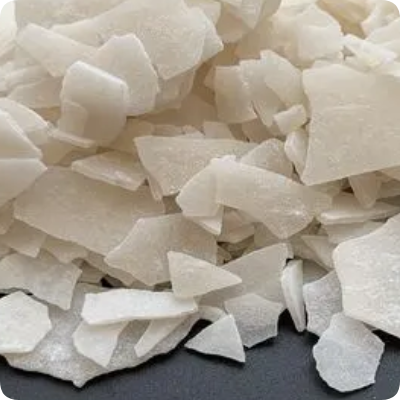
1.3 Mineral-Derived Magnesium Chloride
This refers to products derived from magnesite ore (MgCO₃). The main feature is that the sulfate (SO₄²⁻) content is very low, typically between 0.4% and 1.0%. Because it comes from magnesite mining, the output volume is relatively large. The main cost lies in transportation and processing, so the price is moderate.
II. Acid-Process Magnesium Chloride Hexahydrate
Acid-process magnesium chloride is produced through chemical synthesis — using hydrochloric acid (HCl) and magnesium-containing raw materials (magnesium oxide, magnesium hydroxide, or magnesite) to undergo a chemical reaction, directly synthesizing magnesium chloride, which is then crystallized to obtain magnesium chloride hexahydrate (MgCl₂·6H₂O). This process is the main product line of our Weifang Yuze Magnesium Chloride factory at present. The advantages are quite prominent:
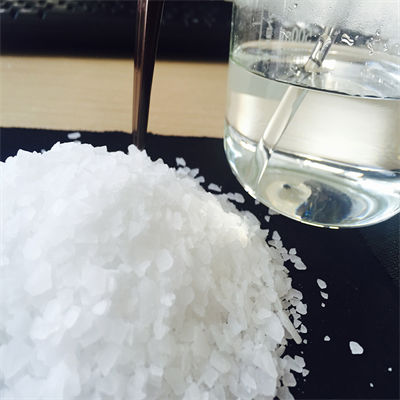
2.1 White in Color
Magnesium chloride hexahydrate made by this process appears transparent white or semi-transparent white.
2.2 High Purity, Few Impurities
Because it is chemically synthesized, the product has low heavy metal content and high magnesium content. It is very close to food-grade magnesium chloride.
2.3 Not Prone to Caking
Since sea transportation can take a relatively long time — sometimes 2 to 3 months at sea — and magnesium chloride hexahydrate inherently has moisture-absorbing properties, anyone who has been in this industry for a long time knows that in the past, shipments would often arrive with slight caking. However, our acid-process magnesium chloride hexahydrate can effectively avoid this problem.
III. By-Product Magnesium Chloride
By-product magnesium chloride is not produced specifically to make magnesium chloride. Instead, it is magnesium chloride that is "incidentally" generated during the production of other main products. It is a by-product, not a primary product. Examples include: by-products from potassium nitrate production, pharmaceutical intermediates, pesticide factories, and the production of soda ash (Na₂CO₃) or raw salt (NaCl) — in these processes, the mother liquor is rich in magnesium chloride, which used to be discharged directly into the sea causing pollution, but is now recovered through concentration and crystallization to produce by-product magnesium chloride.
The main advantage of this by-product magnesium chloride is its low price.
Conclusion
The above is our Yuze Magnesium Chloride manufacturer 's introduction to the differences between products from all magnesium chloride hexahydrate manufacturers in our region. We believe that through this brief introduction, you can better choose the magnesium chloride hexahydrate product you need.
Yuze Magnesium Chloride has been in the magnesium chloride industry (anhydrous magnesium chloride, magnesium chloride hexahydrate) for 13 years, and some of our products have already reached EU certification standards. If you have any related questions, please feel free to contact us at any time.
Previous: Why Magnesium Chloride Flakes Are the Top Choice Among Hexahydrate Magnesium Chloride Products
Next: China hexahydrate magnesium chloride and anhydrous magnesium chloride